About Corbel
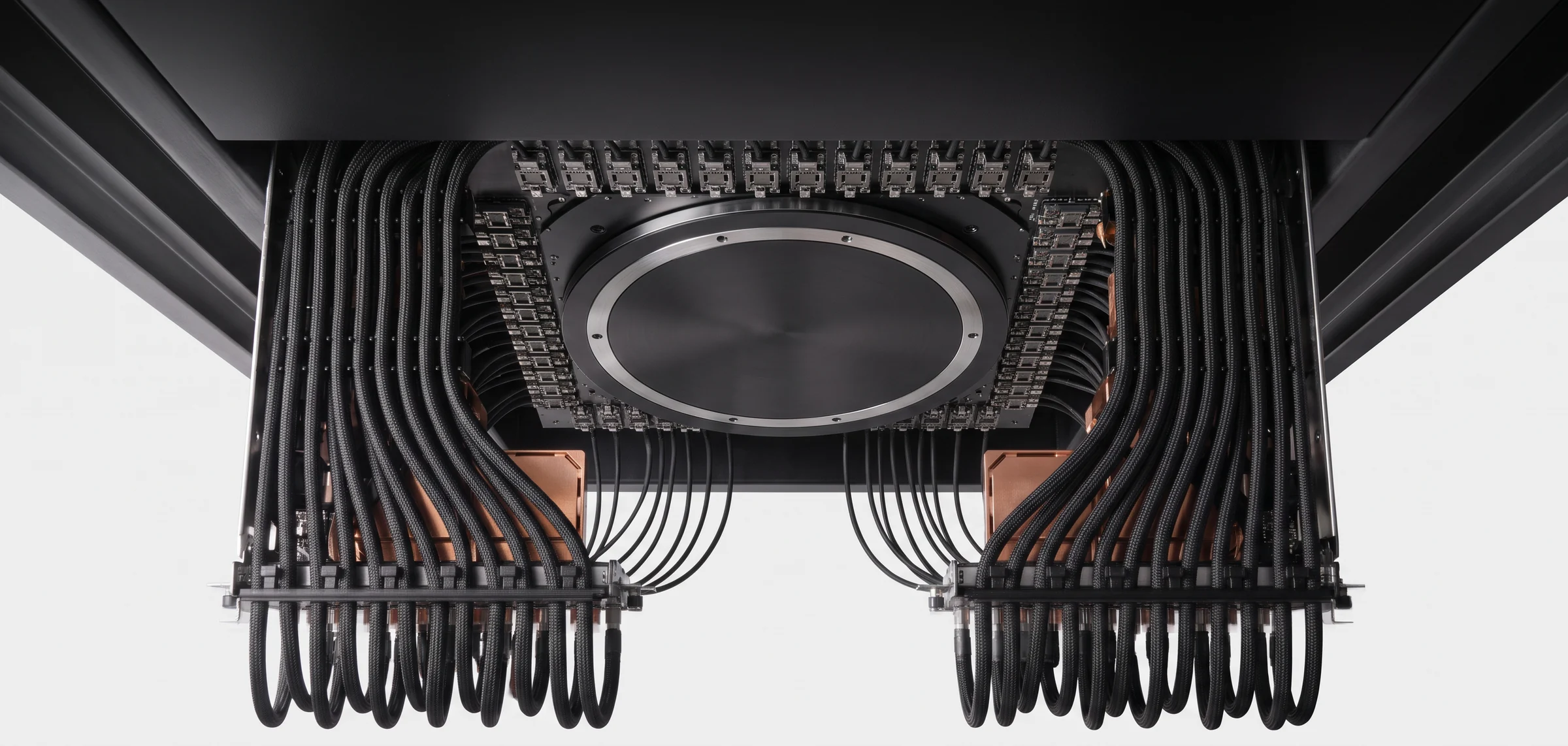
Corbel builds chips in a new way. Arrays of protein nano-arms on DNA scaffolds place carbon nanotube devices at room temperature. Nothing underneath gets cooked, so logic can be built directly on top of memory instead of next to it.
Why it matters: in today's AI chips, most of the energy goes into moving data between logic and memory. Building one on the other shortens that trip to almost nothing. That means more compute out of every watt, at a time when power, not chips, is becoming the limit.
Where we stand
We are at the start. The building blocks are published science: DNA templates that place nanotubes, DNA arms that move under electronic control, and carbon nanotube processors that run code. Nobody has turned them into a manufacturing process yet.
Our first milestone is a dry measurement: arms that move and read out in dry nitrogen instead of water. Our first product is a memory layer added to a finished foundry wafer. We are raising our seed round to get there.
How we build
- Start from physics. Price every step in atoms, energy and time. Market prices and habits are not limits.
- Delete first. If physics does not force a part, a step or a rule of our own, remove it.
- Speed is a cost lever. More experiments per week means a cheaper chip. We automate the lab before we grow the team.
- Many small arms, not one big machine. A failed unit costs us one unit, not the run.
- Aim at the 10x number. 10,000 arms, then 1,000,000. Incremental goals give incremental designs.
- Say it in one line. Everyone on the team can state the current milestone and why it matters.
- Hard rules are physics too. Export control, lab safety and our licence terms are fixed limits. We design inside them from day one.
- Only shipped results count. A placed device, a measured yield, a signed partner. Slides and plans are not results.
Team

Malte Wagenbach
Co-Founder & CEO
Full time on Corbel. Repeat founder across energy, AI and consumer brands. Owns the plan, the money and the partners.

Dr. Jeremy Barton
Scientific Founder
Physical chemist, PhD Northwestern. Over 20 years in nanofabrication, plasmonics and atomically precise manufacturing. Builds computer-controlled nanorobotics.
Open role
Head of Process
First hire from the seed round. Leads the move from wet lab to dry, fab-ready assembly. Process background in MEMS or advanced packaging.
Malte Wagenbach, Co-Founder & CEO
Malte is a repeat founder. Before Corbel he built an e-commerce brand and a software agency, and he has started companies in energy and AI. At Corbel he works full time on the company: the plan, the money, the partners and the road into the fab. He works from first principles: price every step in atoms, energy and time, and delete whatever physics does not force.
Dr. Jeremy Barton, Scientific Founder
Jeremy is a physical chemist with over twenty years of academic and startup research experience. He builds computer-controlled nanorobotics: his first system uses a charged DNA-origami plate that moves in response to an applied voltage, and his goal is to control molecular machines one by one rather than in groups. Jeremy holds a PhD in physical chemistry from Northwestern University. His expertise spans nanofabrication, plasmonics and atomically precise manufacturing.
He works in the open and publishes designs, protocols and negative results with the evidence behind them. In his words: “the lessons that don’t flatter us are the ones the field needs most.”
Work with us
We are hiring our first engineers. See the open roles, or write to hello@buildcorbel.com.